The Armenian Dialects of Karabakh (Artsakh)
Bert Vaux (University of Cambridge)
The Armenian dialects of Karabakh (Armenian Gharabaghi barbaṙ, recently also called the ‘Artsakh dialect’, though spoken far beyond Artsakh’s borders) form one of the most distinctive branches of the Armenian dialect continuum. Shaped over many centuries by contact with Persian, Turkic, and Russian, they combine striking innovations with archaisms long since lost elsewhere, and illuminate the linguistic history of Artsakh and of Armenian more broadly. Although Standard Eastern Armenian was the official language of the Republic of Artsakh, most of its Armenian inhabitants spoke a local dialect in everyday life, frequently alongside Russian.
History and extent
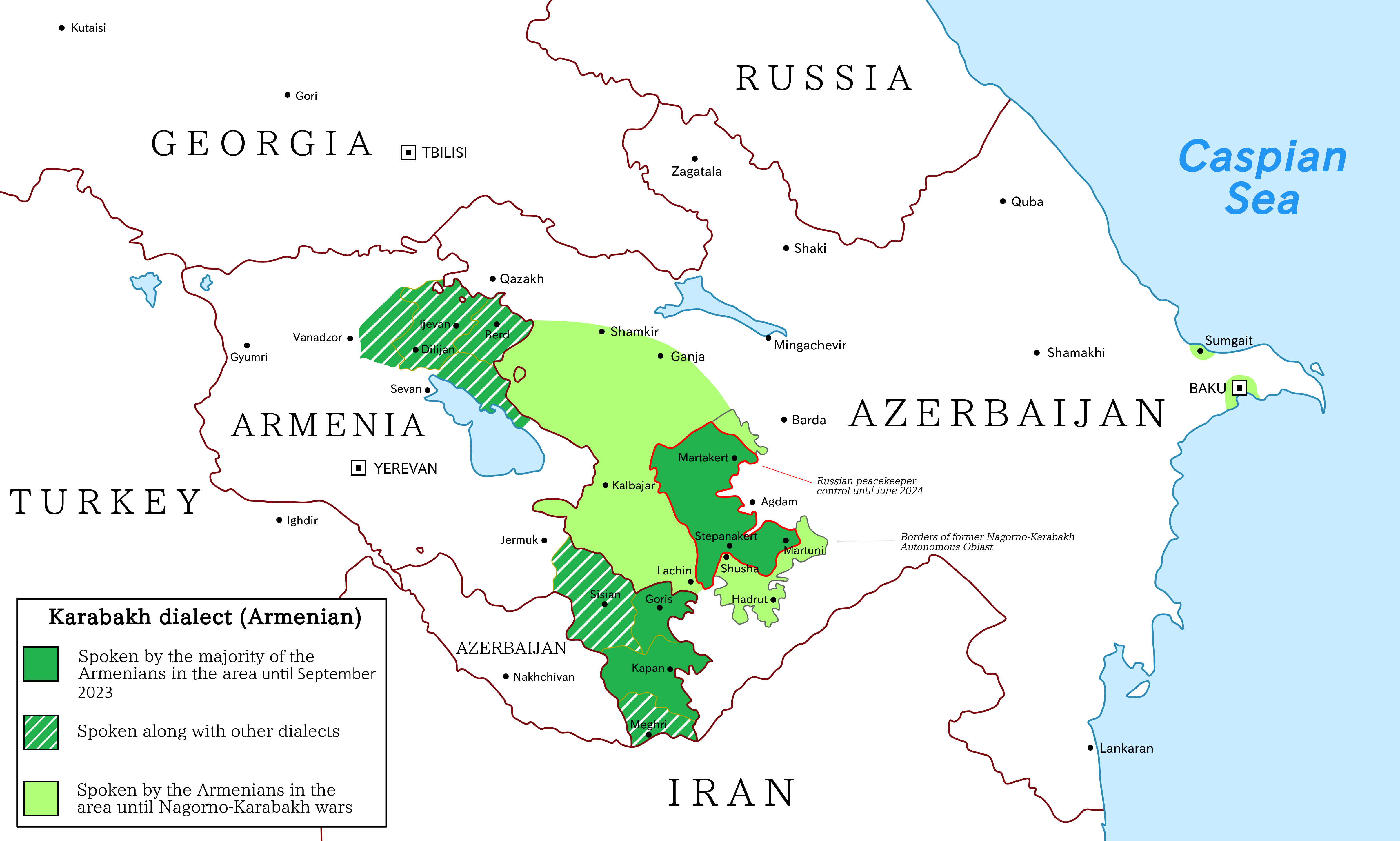
A probable ancestor of the group, the speech of the ancient province of Siwnikʻ, is already mentioned by the eighth-century theologian Stepʻanos Siwnetsʻi (Adonts 1915). By the modern period Karabakh arguably possessed the largest territory (Adjarian 1909) and the largest speaker population of any non-literary Armenian dialect: more than one million speakers in the mid-twentieth century, according to Gharibyan (1953). In 2019 the dialects were spoken by the more than 140,000 Armenians of the Republic of Artsakh (Martirosyan 2019), by sizeable communities in the provinces of Syunikʻ, Gegharkʻunikʻ, Tavush, and Loṙi in the Republic of Armenia, and in a diaspora extending from Russia and Central Asia to the United States. Until 1988 closely related varieties were also widespread in Azerbaijan, both in cities such as Baku, Ganja, Shaki, and Agstafa and in villages stretching from Dashkesan to Mingechaur. The flight of virtually the entire Armenian population of Nagorno-Karabakh in September 2023 has deprived the dialects of their historic heartland.
Internal diversity
Although Karabakh was long assumed to speak a single dialect, Karo Davtʻyan (1966) showed that it in fact harboured at least six dialects belonging to three distinct branches of Armenian. The north (Mardakert and Stepanakert) belongs to the -um branch, which, like Standard Eastern Armenian, forms its present tense from a participle in -um followed by an auxiliary, as in hěvákʻum a ‘s/he gathers’. The Hadrutʻ region in the south and Verin Chʻaylu in the north belong instead to the -lis branch, while the central districts of Martuni and Shushi display mixed characteristics. The northern varieties, conventionally meant by ‘Karabakh dialect’, are the focus here.
A sample text
The survey that follows is organised around the opening of a folk tale, “The Brothers”, from the village of Khndzristan (“Apple Place”; Azerbaijani Almalı) in the Khojaly district, 23 kilometres north-west of Stepanakert (Azerbaijani Xankəndi). It was recited for me in Stepanakert in the summer of 2001 by A. [full name withheld], then an undergraduate at Artsakh State University. An earlier version, told by Pitsi Asruntsʻ Hakobjan, an 82-year-old resident of the village of Nakhijevanik, is published in Abrahamyan (1973). Dialect forms are given below in Library of Congress transliteration.
Transcription
akhpérkʻ
ásum a ókhtě ákhper ěn inúm. chʻǘrě pʻsákvelě sáhantsʻ mets ákhper ě hěvákʻum a akhportántsʻ ě tʻa gyüdüm ě́kʻ hinchʻ ka. munkʻ mihéngy (i)stí seráv ěnkʻ baytsʻ ékʻyütsʻ ámen mínyě mězána píti min khězä́takě hánitsut píri, en vákhtě mer kěnánikʻyě huv á gyǘdüm ǘrür něhét hontsʻ ěn yóla kʻyinä́. munkʻ pití stegh khoskʻ tankʻ, věer munkʻ mer khelkʻ kěnánutsʻ chʻěpíti tankʻ, munkʻ mínchʻyev mer mě́rnelě pití pazhánvinkʻ üchʻ, mer hor ojyákhě kʻándinkʻy üchʻ.
English translation**
Brothers
They say [literally ‘it says’] there are seven brothers. Before getting married, the oldest brother gathers [his] brothers [and says], “You know what? Right now we are united, but tomorrow every one of us may have [literally ‘bear’] a lousy [wife], [and] at that time who knows how our wives may get along with each other? We must promise here that we will not listen to our wives, we must not become separated until we die. We must not destroy our father’s family.”
Pronunciation
Karabakh has developed several vowels not found in the literary language, among them ä (as in English cat), ü (as in German fünf), and the diphthong ěe, as in kʻyinä́ ‘goes’ (Standard Eastern Armenian gna), chʻǘrě ‘before, until’ (standard minchʻev), and věer ‘that’ (standard vor) respectively. Many of these vowels arose through Adjarian’s Law, a sound change that affected the common ancestor of Karabakh, Van, Salmast, Agulis, and several other south-eastern dialects between the seventh and ninth centuries (Weitenberg 2017). It fronted the back vowels a, o, u to ä, ö, ü after voiced consonants, as when Classical Armenian aygutsʻ ‘at dawn’ became Karabakh ékʻyütsʻ ‘tomorrow’. The same forms reveal the subsequent devoicing of the original voiced stops, a change shared with many neighbouring dialects. Karabakh also acquired a system of vowel harmony reminiscent of, though not identical to, that of neighbouring Turkic languages, whereby inserted vowels and certain consonants agree in frontness with the nearest vowel; hence the front kʻy and i of kʻyinä́.
Whereas Standard Eastern Armenian, like French, stresses the last full vowel of a word (amén ‘every’), Karabakh normally stresses the penultimate (ámen). In combinations of a word with an unstressed clitic, moreover, Karabakh may place its high tone on the clitic itself: huv á ‘who is it?’ versus standard óv ē. The dialect also frequently adds h- to originally vowel-initial words: hinchʻ ‘what’ and hánitsut ‘full of nits’ correspond to standard inchʻ and anitsot.
Grammar
Karabakh shares the -um present with the standard language but forms its future with a participle in -akan, as in kʻyěez utlakan ěm ‘I will eat you’ (Abrahamyan 1966). The traditional Karabakh obligative petma is yielding to standard piti, part of a broader levelling towards the standard: where a nineteenth-century teller of the same tale (Abrahamyan 1973) used amma ‘but’ and chʻěkʻelaně ‘until’, a speaker born in the 1980s uses baytsʻ and minchʻyev, all but identical to standard baytsʻ and minchʻev. In syntax, the negative and prohibitive particles follow rather than precede the verb: kʻándinkʻy üchʻ ‘let us not destroy’ (standard chʻkʻandenkʻ) and piril mi ‘do not bring’ (standard mi berir). Further syntactic characteristics are catalogued by Martirosyan (2001).
Vocabulary
The lexicon is perhaps the most divergent component of the dialect, and has been the subject of several substantial dictionaries (notably Sargsyan 2019). Some words descend from the same ancestors as their literary counterparts but have been transformed almost beyond recognition, such as khókha ‘child’ (standard erekha) and yékhtsi ‘church’ (ekeghetsʻi); others have shifted in meaning, as with něghátsʻal ěm ‘I am tired’ beside standard neghatsʻel em ‘I am offended’. Still others are unique to the region, such as lokh ‘all’ (standard bolor). Turkic loans include ojyákh ‘family’ (literally ‘hearth’) and vakht ‘time’, itself ultimately from Arabic waqt. The idiom is vivid: a sullen child may be asked eshit huv a chʻu asal? ‘who said “giddy-up” to your donkey?’, and one wards off misfortune by warning kěchʻěgháku něman kěrkěra měer, literally ‘do not cackle like a magpie’.
Russian, the principal medium of education, administration, and social mobility in the Soviet period, has contributed a further layer: pʻabrika ‘factory’, stalavoy ‘canteen’, televizor ‘television’, the discourse markers karachʻo ‘in short’ and davay ‘all right’, and military terms that acquired grim currency during the Azerbaijani invasions of 2020 and 2023, such as pekhota ‘infantry’. Some Russian words arrived by way of Azerbaijani: tʻělěghram ‘telegram’ reflects Azerbaijani teleqram rather than Russian telegramma directly (Shahnazarian 2024).
Conclusion
Until September 2023 the Karabakh dialects were not merely a medium of daily communication but a pillar of Karabakh Armenian identity, embodying centuries of regional history and sustaining a sense of community and continuity through prolonged conflict. With their speakers now dispersed across Armenia and beyond, and under mounting pressure from Standard Eastern Armenian, the dialects face an uncertain future. Their documentation and study are accordingly more urgent than ever, for Armenian linguistics and for the cultural heritage of Artsakh.
Bibliography
Sources
Abrahamyan, G. (ed.), Հայ ժողովրդական հեքիաթներ [Armenian folk tales], vol. 5, Erevan: Academy of Sciences of Armenia 1966.
Abrahamyan, G. (ed.), Հայ ժողովրդական հեքիաթներ [Armenian folk tales], vol. 6, Erevan: Academy of Sciences of Armenia 1973.
Research literature
Achaṙean, H., Քննութիւն Ղարաբարի բարբառին [Study of the Karabakh dialect], Vagharshapat: Mother See of Holy Ejmiatsin 1901.
Adjarian, H., Classification des dialectes arméniens, Paris: H. Champion 1909.
Adonts, N., Дионисий Фракийский и армянские толкователи [Dionysius Thrax and the Armenian commentators], Petrograd: Imperial Academy of Sciences 1915.
Davtʻyan, K., Լեռնային Ղարաբարի բարբառային քարտեզը [Dialect map of Nagorno-Karabakh], Erevan: Academy of Sciences of Armenia 1966.
Gharibyan, A., Հայ բարբառագիտություն [Armenian dialectology], Erevan: State Correspondence Pedagogical Institute of the Academy of Sciences of Armenia 1953.
Martirosyan, H., “Materials on Syntax of the Armenian Dialect of Łarabał”, unpublished manuscript, Los Angeles: University of California 2001.
Martirosyan, H., “The Armenian Dialects: Archaisms and Innovations; Description of Individual Dialects”, Armjanskij gumanitarnyj vestnik 5 (2019), p. 164-258.
Sargsyan, A., Ղարաբարի բարբառի բառարան [Dictionary of the Karabakh dialect], 2nd rev. ed., Erevan: Editʻ Print 2019.
Shahnazarian, N., “Linguistic Landscape in the Former de facto Nagorno-Karabakh: (Post-) Soviet Transition and the Status of the Russian Language”, unpublished manuscript, Erevan: Academy of Sciences of Armenia 2024.
Weitenberg, J., “The Dialectology of Armenian”, in J. Klein – B. Joseph – M. Fritz (eds.), Handbook of Comparative and Historical Indo-European Linguistics: An International Handbook, vol. 2, Berlin – Boston: De Gruyter Mouton 2017, p. 1132-1146.